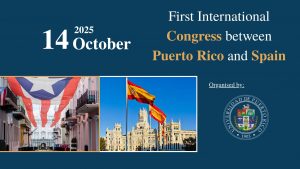
First International Congress between Puerto Rico and Spain
A Reflection by D.B. Cruz de la Torre
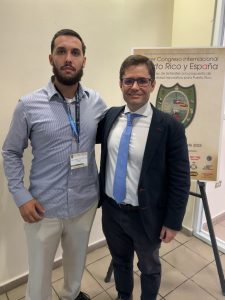
Thanks to Dr. Nieve de los Ángeles Vásquez, Escuela Hispánica had the opportunity to participate in the first International Congress between Puerto Rico and Spain on October 14, organized by the Department of Humanities at the University of Puerto Rico, Bayamón. The congress took place over four days with the aim of celebrating and remembering Hispanic heritage and Spain’s legacy in Puerto Rico, following the celebration of Hispanic Day (October 12). Speakers came mainly from Spain and Puerto Rico, as well as other countries such as Argentina, the Philippines, Italy, the United Kingdom, and the United States. Escuela Hispánica was represented by David Cruz de la Torre, who presented a paper on Puerto Rico and its ties to the School of Salamanca during the first day of the congress.
Many topics were addressed, including those examining shared cultural roots and histories:
-
Bishop Pablo Benigno Carrión, recognized as the spiritual bridge between Andalusia and Puerto Rico.
-
The Camino de Santiago and its significance for Western culture.
-
The annus mirabilis of the Hispanic monarchy in Brazil, the global impact of the conquest, and the recovery of Salvador de Bahía.
The second day focused on the role of notable San Juan figures in Hispanic history, such as Juan Alonso Zayas, one of the leaders of the Second Expeditionary Battalion of Baler, the same group involved in the famous episode of “The Last of the Philippines,” and Ramón Power y Giralt, vice president of the Cádiz Cortes and, through the Cádiz Cortes, Puerto Rico’s projection in the constitutionalism of Spain, Ibero-American countries, and Equatorial Guinea.
One thematic session that stood out to me was the presentation of four UNESCO World Heritage cities: Naples, Salamanca, Alcalá de Henares, and San Juan. Among these, Naples is particularly striking, having experienced a significant period under Spanish rule, becoming part of the Spanish Empire in 1503 and governed by Spanish viceroys until 1707.
Less recognized outside of Spain is the central role of Cardinal Francisco Jiménez de Cisneros and his concept of Civitas Dei in the development of the modern university city. Civitas Dei refers to the City of God, an ideal city concept that originated at the University of Alcalá de Henares, founded by Cisneros himself. This model university city served as an example for other universities across Europe and the Americas. Civitas Dei became the model for the ideal urban community that Spanish missionaries carried to the Americas. The influence of Alcalá de Henares can be seen in the universities of San Marcos in Peru, Santo Domingo in the Dominican Republic, and the Royal and Pontifical University of Mexico. Spanish influence is also evident in cities such as La Laguna (Canary Islands), Santo Domingo, Cartagena de Indias, and other cities across the Americas. Between Alcalá de Henares and Salamanca, one can understand how Spain replicated itself in the Americas and fostered a strong civilizational bond among Ibero-American countries.
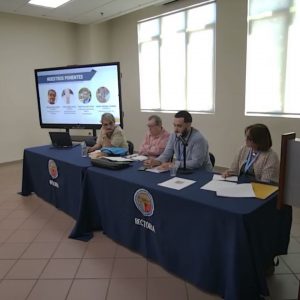
The following morning, thematic sessions were organized on María Zambrano, Spanish exiles in Puerto Rico, and historical notes on Canarian and Balearic immigration to Puerto Rico in the 19th century. The First International Congress between Puerto Rico and Spain aims to pave the way for future conversations about their relationship, placing particular emphasis on the Sephardic law and Puerto Rico’s proposed reparative nationality. While the topic raises more questions than answers, it is notable that these questions are presented before dozens of students, with sponsors such as the Spanish Ministry of Culture, the autonomous cities of San Juan and Bayamón, the City Council of Vélez-Málaga, companies like Hyatt Hotels and Goya, and foundations such as María Zambrano and Heriberto Nieves.
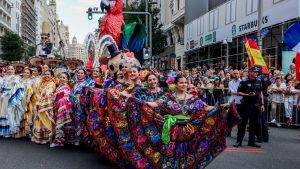
The vast majority of topics at the first congress underscore the importance of Escuela Hispánica in exploring the Hispanic tradition of liberty. As Juan Ángel Soto notes in his recent publication The Empire Strikes Back, there is a civilizational continuity that endures between Spain and its former colonies. The only other European country maintaining relations with its former colonies at this level is Portugal for similar reasons. Puerto Rico remains Hispanic and, more than sharing a heritage, in Puerto Rico’s faces one sees connections with other Caribbean countries, such as Cuba and particularly the Dominican Republic; with other Ibero-American countries such as Mexico, Argentina, Panama, Colombia, and Venezuela; and with Spanish communities such as the Canary Islands, Balearic Islands, Catalonia, Galicia, and the Basque Country.
The First Congress reflects Puerto Rico’s desire to strengthen its ties with Spain. Furthermore, knowing that this year marked the first participation of the Philippines and Puerto Rico in the Grand Hispanic Parade 2025 with a total of 23 countries represented, it is clear that Puerto Rico is not the only heir country seeking to strengthen its relations with Spain and among Ibero-American countries themselves.
Date
- Oct 14 - 18 2025
- Expired!
Location
- Carr. 174 Núm. 170 Industrial Minillas Bayamón, Puerto Rico 00959-1919
-
Website
https://www.upr.edu/upr_bayamon/ -
Phone
(787) 993-0000 Extensión: 4015
Category
Organizer
-
Department of Humanities UPRB
-
Phone
(787) 993-0000 Extension: 4015 -
Website
https://www.upr.edu/upr_bayamon/