Escuela Hispánica’s Participation in the American Politics & Government Summit (ISI)
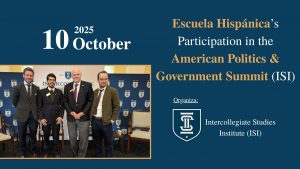
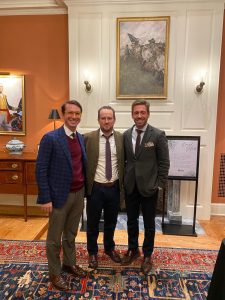
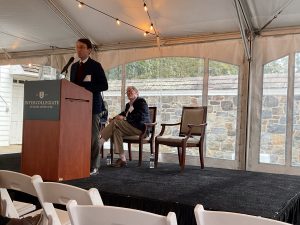
As part of the American Politics & Government Summit organised by the Intercollegiate Studies Institute (ISI), four members of Escuela Hispánica —Alex Chafuen, Juan Ángel Soto, Enrique Pallarés and José Sáenz Crespo— took part in a round table dedicated to exploring the Hispanic scholastic roots of liberty and moral economy: Hispanic Scholastic Roots of Ordered Liberty and Economic Thought. The discussion combined intellectual history, political philosophy, and contemporary reflection, offering an alternative —and complementary— reading of the Anglo-liberal tradition.
Alex Chafuen opened the session with an intervention that was both personal and erudite. He recalled his journey from Objectivist philosophy to the rediscovered Catholic tradition of liberty, in which “economics began in the confessional”. Those cases of conscience —whether a merchant should disclose information, whether a price was just, whether authority abused monetary power— were not mere moral dilemmas but early exercises in economic thought. In the Scholastic tradition, Chafuen explained, economic reflection was inseparable from ethics and anthropology. Economics was understood as a branch of prudence: the study of human action under the principle of justice.
From there, he reconstructed a thread linking Saint Thomas Aquinas, the Franciscan precursors, and the Spanish Scholastics to the birth of modern economics. Their emphasis on subjective value and the relationship between just price and free market —“without monopoly, fraud, or coercion”— anticipated key notions later formalised by the Austrian School. Chafuen also underscored the role of Juan de Mariana, who united moral reflection with institutional critique: manipulation of currency, warned the Jesuit, was not merely a technical error but an act of social injustice. In his De Rege et Regis Institutione, Mariana proposed a republican monarchy founded on virtue and respect for the natural order, recognising that political power, when detached from morality, inevitably decays into tyranny.
Juan Ángel Soto then situated that legacy within the broader architecture of Western civilisation. He proposed including the City of Salamanca in the genealogy of the roots of the West, alongside Jerusalem, Athens, Rome, London, and Philadelphia —not as an act of nationalist assertion but as a historical rectification. The Hispanic tradition, he explained, acted as a bridge between medieval Christendom and the Enlightenment, preserving the notion of natural law and enriching it with a reflection on liberty understood not as mere absence of coercion but as a moral exercise directed towards the good.
“Freedom from is insufficient without freedom for,” he noted. “Liberty, without an idea of the good to which it is ordered, dissolves into arbitrariness.”
Soto also warned of a contemporary misunderstanding: the politicised use of Hispanidad as a tool of geopolitical opposition to the United States. Against these antagonistic readings, he proposed understanding the Hispanic tradition as a constitutive contribution to the Western project, not as its negation. “Today’s West,” he affirmed, “cannot stand upon a single column —the Anglo-Saxon one—; it needs the others, especially the Hispanic, which offers a more complete anthropology and a more moral conception of political order.” Enrique Pallarés brought the discussion into the philosophical and existential realm, introducing Miguel de Unamuno as heir to the Scholastic tradition and prophet of modern crisis. Unamuno —he recalled— foresaw, before anyone else, the danger of depersonalisation: the replacement of the concrete individual by the abstract being, the man of flesh and bone by a faceless “humanity”. Against the dominance of instrumental reason and mass politics, the Basque thinker sought to restore the centrality of the person. For him, to be a person did not mean to isolate oneself, but to live in tension between the visible and the eternal, between history and the soul.
“There is no other politics,” wrote Unamuno, “than to save the person in history.”
Pallarés underscored the theological depth of that affirmation: politics ceases, then, to be a mere engineering of power and becomes a moral task, oriented towards the salvation of the concrete person. In this personalist vision —heir to Christian anthropology and, ultimately, to Scholasticism— lies, he argued, the key to addressing the contemporary crisis of liberal civilisation. If the twentieth century was the century of ideologies and the twenty-first risks becoming that of indifference, the response must be to restore the dignity of the person to the centre, against the abstractions of market, state, or mass.
The exchange between the three speakers revealed a shared insight: liberty without form or purpose leads to chaos, and order without liberty leads to oppression. The Hispanic tradition, from Francisco de Vitoria to Unamuno, sought a balance between the two —an order grounded in natural law, recognising limits to authority while directing freedom towards the good. This “ordered liberty” is, according to Soto, the key to any political reconstruction capable of resisting both technocratic and populist temptations.
During the dialogue with the audience, participants addressed questions such as the tension between natural law and sovereign will, the real influence of the Scholastics on Locke and Smith, and the legacy of the Council of Trent in the development of modern political thought. Soto emphasised that the aim was not to decide who was “right” —the Reformation or the Counter-Reformation— but to rediscover the points of convergence that laid the foundations of the Western world: the primacy of law over power, the dignity of the person, and the central role of virtue in public life.
Chafuen added an important remark: Protestant and Catholic cultures, he said, have cultivated complementary dimensions of modern civilisation —respect for law, in one case; moral and philosophical depth, in the other— and the future of the West will depend on their reconciliation.
In parallel with this round table, another member of Escuela Hispánica, Felipe Mosquera, took part in a different panel, where he highlighted the influence of Jovellanos within this tradition.
More than a historical lesson, the ISI session was an exercise in civilisational re-reading. The speakers from Escuela Hispánica offered a narrative in which the Iberian and American universities of the Golden Age emerge as a missing link between Christendom and liberal modernity; where liberty, far from opposing morality, is founded upon it; and where the person —not the mass, nor the state, nor the market— regains its place as the measure of all political order.
As Soto concluded in his final remarks:
“The task is not to overcome modernity, but to remember that before it there already existed a deeper, more human, and more moral tradition of liberty —and that recovering it may well be the essential task of our time.”
Date
- Oct 10 2025
- Expired!
Location
- 3901 Centerville Road, Wilmington, DE 19807, United States of America
Category
Organizer

-
Intercollegiate Studies Institute (ISI)
-
Phone
+1 800-526-7022 -
Email
info@isi.org -
Website
https://isi.org/