Project 1776
Hispanic Scholasticism and the U.S. Declaration of Independence
At Escuela Hispánica, we have launched Project 1776, a research initiative developed to mark the 250th anniversary of the United States Declaration of Independence (1776–2026). This project explores the influence of Second Scholastic political thought—particularly that of the School of Salamanca—on the intellectual origins of American constitutionalism and on the defence of individual liberty against absolute power.
Several scholars have highlighted that many principles we now regard as cornerstones of modern democracies—such as popular sovereignty, limitation of power, and respect for individual conscience—were formulated centuries earlier by Catholic theologians and jurists of the 16th and 17th centuries. A key example is the celebrated formula of the Jesuit Francisco Suárez (1548–1617): “Omnis potestas a Deo, populum consentientem” (“All power comes from God, but through the consent of the people”). This conception of political authority as delegated by the community, rather than as absolute power granted directly to the monarch, challenges the common notion that Catholic thought in the Early Modern period supported absolutism. In fact, it was often Protestant reformers—both Lutheran and Anglican—who defended monarchical models “by the grace of God.”
The scholars of the School of Salamanca, influenced by Thomas Aquinas and led by figures such as Francisco de Vitoria, Juan de Mariana, Robert Bellarmine, and Suárez himself, developed a theological and juridical vision of political order grounded in natural law, moral law, and rationality. These ideas spread through universities, seminaries, and libraries, both on the Iberian Peninsula and in Ibero-America, forming what we might today call a genuine “Hispanic tradition of liberty.”
Traditionally, academic studies have focused on the impact of this tradition during the processes of Ibero-American independence (1810–2010). Researchers such as Carlos Stoetzer, Father Furlong, and contemporary initiatives like Fe y Libertad have shown how the Scholastics influenced emerging republican doctrines in Ibero-America, particularly through the Jesuit educational network.
However, Project 1776 expands this horizon to examine its potential influence on the independence of the United States. Although the Anglo-American world did not possess a Scholastic institutional infrastructure as developed as in Ibero-America, there is growing evidence of the circulation and reception of Hispanic authors—especially Suárez and Bellarmine—in the British colonies. This is suggested by the work of scholars such as Rafael Termes, recent research on George Mason, and reflections by Professor Karl Maurer, who noted:
"It is undeniable that Thomas Jefferson, author of the Declaration of Independence, and George Mason, author of the Virginia Declaration of Rights, were well acquainted with the great classical and contemporary thinkers from Aristotle onwards. It is not unreasonable to conclude that they were also familiar with writers who advocated popular sovereignty and opposed the absolute power of kings."
Catholic Culture
A decade ago, the President of the Escuela Hispánica, Alejandro Chafuen, explored this line of research in an article published in Forbes: “Hispanics Finding Roots and Helping Build Our America”. More recently, José Sáenz Crespo revisited this issue in an interview for the Intercollegiate Studies Institute with Juan A. Soto and Enrique Pallares (see interview), emphasising the need to rediscover a “Hispanic tradition of liberty”, unjustly overlooked in Anglo-American narratives.
The aim of this project, therefore, is not only to recover an alternative intellectual genealogy to the Enlightenment-Protestant account of the origins of the United States, but also to demonstrate how Catholic political philosophy—when grounded in the dignity of the person, natural law, and moral freedom—can contribute to the universal ideals of justice and limited government. A story to be rediscovered on the 250th anniversary of the Declaration of Independence.
This project is structured around several key areas:
- Comparative studies between the Ibero-American and United States independence movements.
- Research on the influence of the Hispanic tradition of liberty on the Founding Fathers of the United States and the process of independence from Britain.
- Publications examining the impact of the Hispanic tradition—rooted in Scholastic thought—on Anglo-Saxon political traditions (Scottish Enlightenment and British empiricism) and, subsequently, on Anglo-American political thought.
- In-person events (primarily in Spain and the United States) and virtual activities (webinars and podcasts) addressing the topics above.
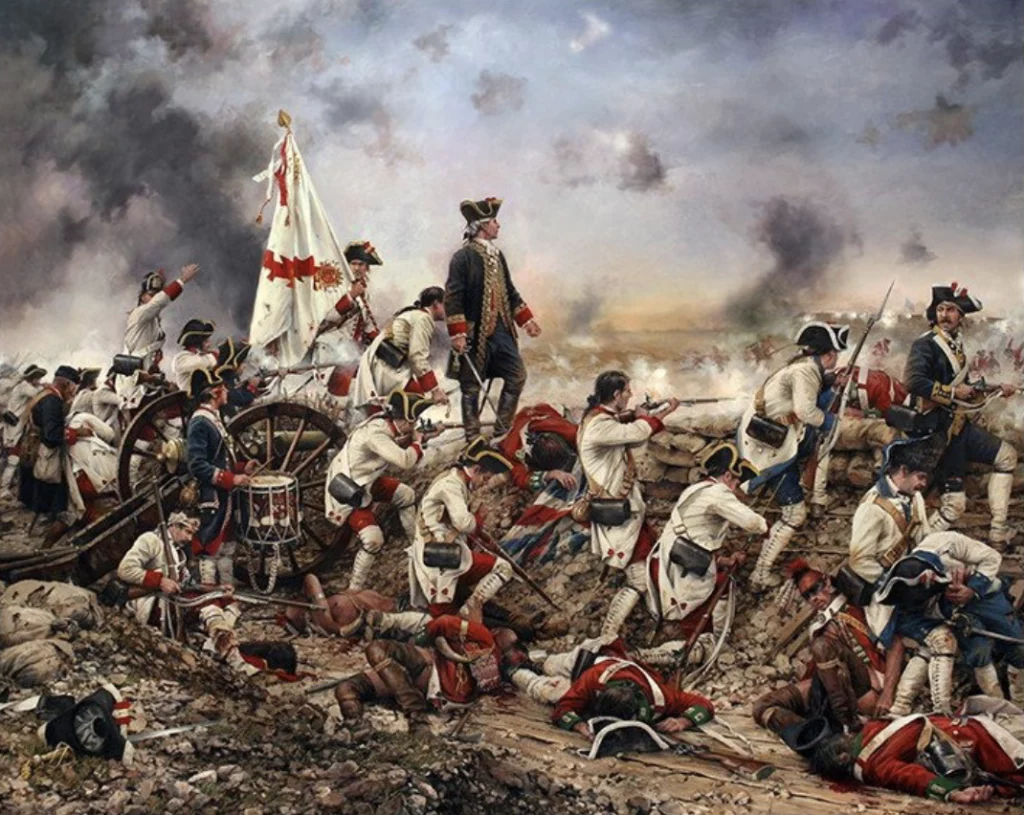
The painting depicts a battle scene from the American War of Independence, highlighting Spanish involvement. It shows Commander Bernardo de Gálvez leading his troops from a fortified position, with soldiers firing and waving the Spanish flag. The image conveys the courage, determination, and sacrifice of the Spanish soldiers in support of the American cause of independence.
“For Spain and the King, Gálvez in America” – Augusto Ferrer-Dalmau
Project 1776 aims not only to recover a forgotten intellectual genealogy, but also to offer an alternative—Hispanic, humanist, and Catholic—perspective on the birth of modern constitutionalism.
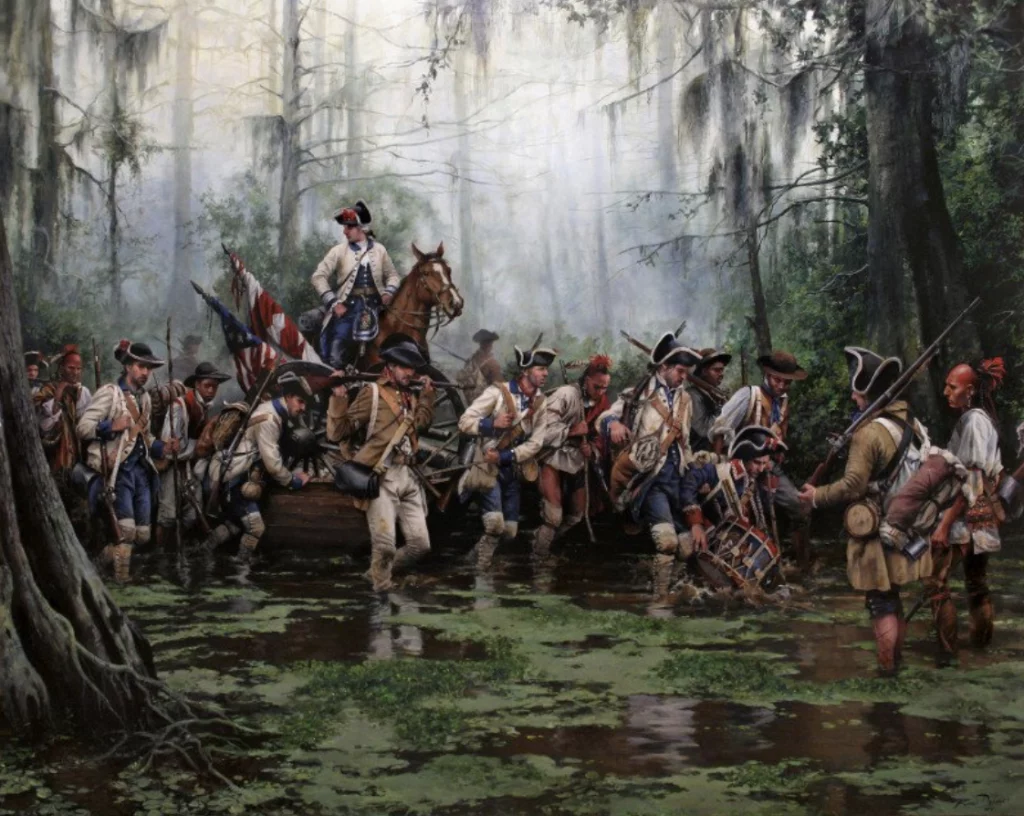
This painting depicts General Bernardo de Gálvez leading his troops through a swamp during the American War of Independence campaign. Carrying both a Spanish and an American flag, Gálvez, on horseback, guides his men as they struggle through the water and vegetation. Soldiers of various backgrounds, including Native Americans, take part in the march, reflecting the diversity and determination of the army fighting for liberty.
“Gálvez’s March” – Augusto Ferrer-Dalmau
The material flourishing or progress of civilizations does not always go hand in hand with the depth of their underlying philosophical principles. Yet these two dimensions—moral and material—cannot endure over time unless they advance together. This appears to be the case in the West today, where socio-economic development is beginning to show signs of decline, largely due to a neglect of its philosophical foundations.
Part of this widespread erosion stems from the fact that, for more than two centuries, virtually the entire weight of the Western project has rested—one way or another and for countless reasons—on the Anglo-American tradition. Yet it increasingly appears incapable of bearing such responsibility alone. The identification of the Western project solely with this tradition is mistaken. On the contrary, we must recognise that the West is, at the very least, the sum of the Anglo-American tradition, the Hispanic tradition, and a constellation of smaller Continental European traditions.
In this light, Project 1776 seeks to dust off the Hispanic tradition—long overlooked or forgotten by both insiders and outsiders—revitalise it, and place it at the service of our societies and of the West, as a complementary and necessary counterpart to the Anglo-American tradition. It is precisely in the New World, and particularly in the United States, where these two traditions meet, reinforce each other, and bear the mature fruit of our civilisation.
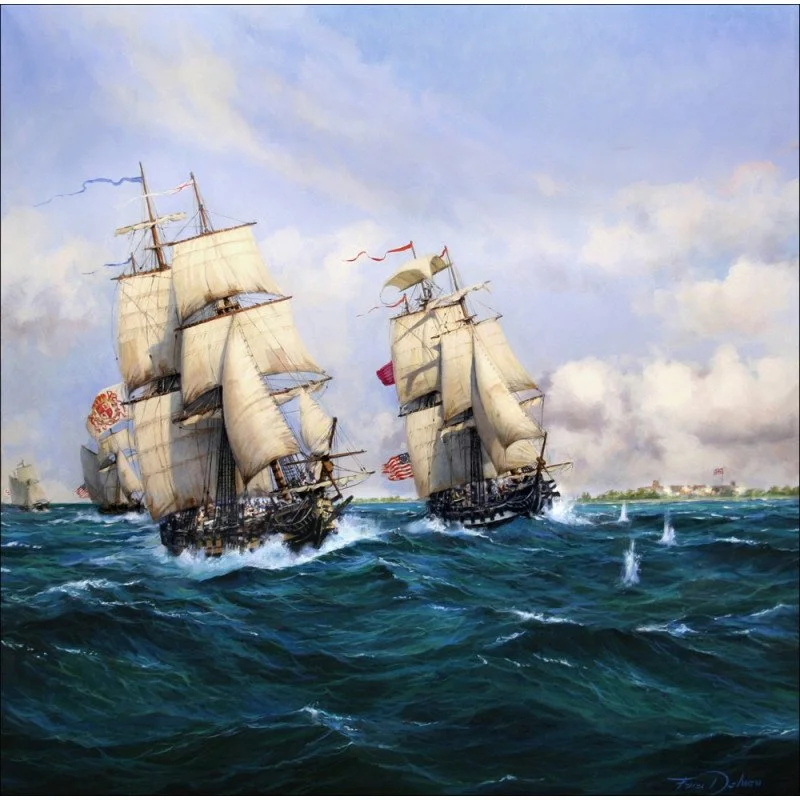
This painting depicts two majestic ships—one Spanish and one American—sailing together while engaging British coastal batteries. The sails are full of wind and the flags fly proudly, symbolising unity and camaraderie amid conflict. The proximity of the shore, together with the smoke and fire of the coastal cannons, adds a sense of urgency and bravery. The painting captures a moment of struggle and loyalty within the tumultuous naval theatre.
“Brotherly Flags” – Augusto Ferrer-Dalmau