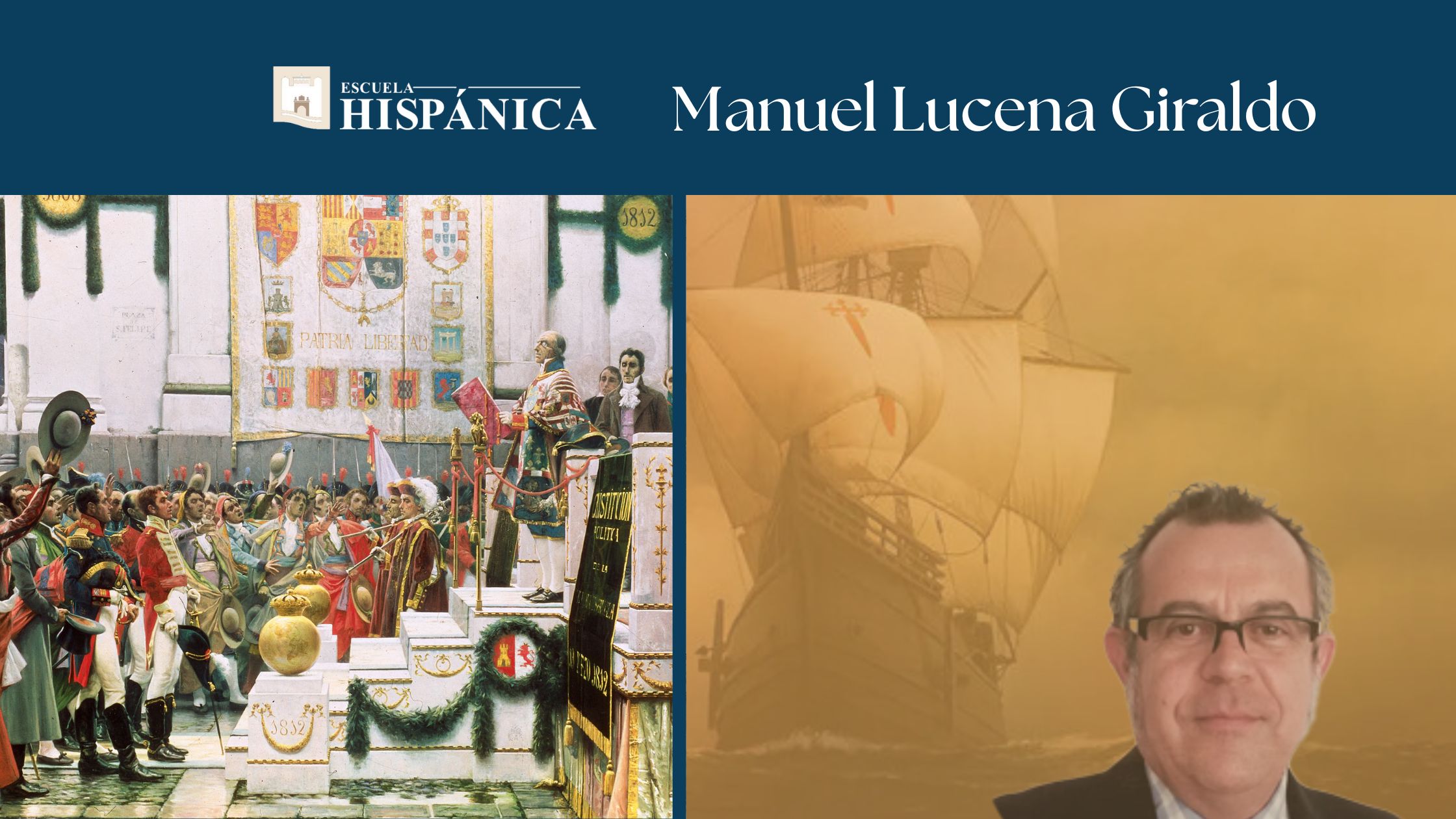
Those who understand commemorations and celebrations say that when a society is ignorant of its past, it replaces history —which serves to restore complexity and illuminate options for present and future freedom— with a mythical memory. That is, a fictional narrative serving particular, partisan, demagogic, and populist interests. The moral economy of this reasoning does not conceal the temporary virtue that fiction can possess —whether textual, visual, in 3D, or generated by artificial intelligence.
Indeed, the virtues of the cultural consumption of this placebo are undeniable. Looking the other way can be —even must be— comforting. Yet both the purgative effect it holds —imagination does not solve problems, but it keeps us entertained in the meantime— and the moral relegation it entails —for fictionalization dismantles lives and livelihoods, and corrodes meritocracy— only deepen the unease.
This unease never disappears. “What happens to us (Hispanics) is that we do not know what is happening to us,” we might say, as we attempt to understand —that is, to essay, in the spirit of Montaigne and Ortega— some new point of view that may illuminate something different. As the following writings show, there are certain consensuses among the authors that draw attention. The first concerns the evidence that, in the past, something was done well —that we did something well— on a global scale. The Hispanic monarchy of the first globalization had its share of miracle. Politically and culturally, it worked. Despite the nineteenth-century mantras that insisted on blaming it for every kind of folly, the Baroque distillation in which it materialized achieved a virtuous and flexible squaring of the circle. Enough to assimilate, from the Enlightenment onward, components of hierarchy and order that were not irreversible —in the sense of not being constitutionally contradictory— or, if you prefer, endowed with a sufficient capacity for self-correction and renewal.
That modernity —so Neapolitan and Enlightened, to put it simply— represented a possible, convincing, and operative imperial and enlightened project within the realm of the real, not merely the imagined. Its elites, of diverse ethnicities, possessed an arsenal of ideas capable of softening rigidities, of assuming that they expressed a divine will, and even of defining a way of being a Spanish nation —European and American— that predated the ethnic nationalisms of the nineteenth century.
It lasted until Napoleon and his French mercenary soldiers arrived, destroying the fabric of imperial European Spain through invasion. Then came the inevitable and tortuous disintegration of independence, in two phases: that of continental America up to 1825, and that of the island overseas provinces in 1898. This process unfolded in an induced civil war context that reflected not failure, but the prior fragmentation of the Spanish imperial elites —irresponsible and short-sighted.
It is fascinating —and this is another crucial argument evident in the following pages— that the foundational Hispanic nationalisms were so convergent. Both those who designed nineteenth-century Spain and those who conjured “from thin air” the republics of Chile or Venezuela, or the Mexican Empire, all began from similar materials. Determined to appear different, in the ferocious competitive world of the British, French, Belgian, American, or German imperialisms, they opted for mimesis —a supposedly virtuous race to imitate, even through self-mutilation, the invincible models of global competitive capitalism. These have, in the end, lasted less than the Spanish Empire itself —at least in its capacity to represent a universal and not (so) incendiary globalization.
In the end, we must ask ourselves about the recent developments of this Hispanic agitation. The great contrast between the density and strength of our historical and cultural bonds, and the weakness of our political, economic, and even symbolic relations, points —without a novel to fix it— to a problem: ourselves. To the terms of our global conversation and presence. We are a community, but we do not know how.
Manuel Lucena Giraldo
Director of the Chair of Spanish Language and Hispanic Studies, Universities of the Community of Madrid
Originally published in Revista de Occidente, ISSN 0034-8635, No. 509, 2023, pp. 5–7.