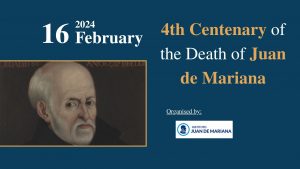
4th Centenary of the Death of Juan de Mariana
Mariana and the School of Salamanca: Origins of Modern Rights and Economics
This Saturday, February 17, marks four centuries since the death of Juan de Mariana (1536-1624), a key figure of the School of Salamanca and one of the most influential thinkers in Spanish political and economic thought. To commemorate his legacy, the Ateneo de Madrid will host an event organized by the Instituto Juan de Mariana, with the collaboration of Escuela Ibérica, where researchers will discuss the relevance of his ideas today.
Inspiration for Freedom and Modern Thought
Juan de Mariana was a theologian, historian, and mentor to the future Philip III. As a defender of tyrannicide against monarchs who oppressed the people, Mariana influenced historical processes that transformed the Old Regime, from the independence of the United States to the French Revolution of 1789. Although his ideas on limiting royal power and defending private property were revolutionary in his time, today they are recognized as foundations of political and economic liberalism.
León Gómez Rivas, professor of History and Economic Thought at the European University of Madrid, emphasizes:
“After going unnoticed for so long, it seems we are beginning to recognize the contribution of the School of Salamanca, on the same level as Cervantes or Velázquez in the Golden Age.”
Among his most notable works are General History of Spain and the educational manual for the prince, commissioned by Philip III. In them, Mariana develops surprisingly modern ideas about economics: he warns against currency manipulation, defends private property, and maintains that taxes must be voted on in the Cortes, not imposed unilaterally by the monarch.
The Limits of Power and the Legitimacy of Resistance
One of Mariana’s most debated concepts is tyrannicide: the possibility of removing a ruler when they become an unbearable tyrant. This idea had historical impact in France and England, influencing even debates on the execution of kings and the spread of democratic principles to the New World.
Pedro López Arriba, vice president of the Ateneo de Madrid, adds:
“These Spanish contributions, despite having been erased, laid the foundations for modern political thought. Mariana taught that the greatest risk for any society is tyranny, and that it must be resisted, through ideas or action.”
Mariana and the School of Salamanca: Origins of Modern Rights and Economics
Together with Francisco de Vitoria and Francisco Suárez, Mariana contributed to the creation of the foundations of international law and human rights, ideas that later influenced figures such as Thomas Jefferson and the Declaration of Independence of the United States.
Manuel Llamas, director of the Instituto Juan de Mariana, explains:
“Mariana’s thinking reminds us that political power cannot commit excesses. Whether represented by absolute monarchies or modern democracies, citizens’ natural rights and property must be respected.”
Contemporary Relevance
The Marinian reflection on the limits of power and respect for fundamental rights remains relevant today. According to Gómez Rivas:
“Mariana and the authors of the School of Salamanca teach us that dismantling the principles of natural law is dangerous. Spontaneous order and respect for the basic rules of society are essential for its stability.”
The event at the Ateneo de Madrid will bring together experts in history, politics, and economics to analyze how these ideas, created more than four centuries ago, continue to influence modern understanding of liberty, property, and justice.
Date
- Feb 16 2024
- Expired!
Time
- 6:00 pm