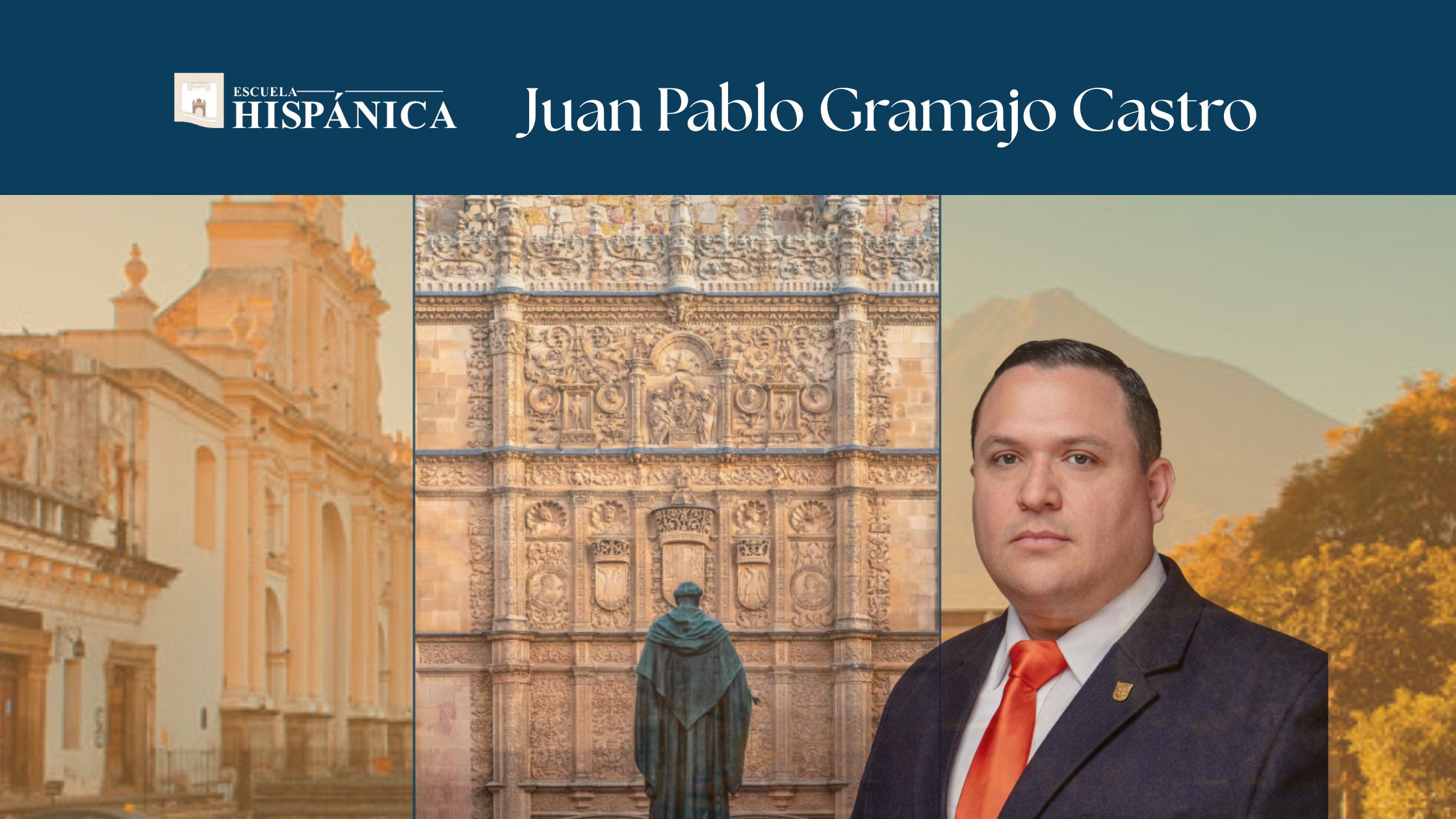
From 12 to 15 October I had the pleasure and honour of taking part in the colloquium “Echo of Salamanca”, organised by the Instituto Fe y Libertad in La Antigua Guatemala.
Scholars from several countries and academic disciplines had the opportunity to learn from one another, reflecting together on the historical influence and present-day relevance of the ideas associated with the so-called School of Salamanca.
Among several interesting points—discussed with critical acumen and respect for differing perspectives—I would like to share three aspects that I found especially enriching.
Primacy of Attitude
In one of the readings for the colloquium, Sebastián Contreras (who was also a participant) notes, among other characteristics, the “particular sensitivity of the magni hispani towards the concrete problems of their time and their openness to the historical”, and how, although enriched by their intellectual allegiances, “none of them limited himself to slavishly repeating the master”.
This openness to the historical, the author affirms, is also expressed in a realist natural-law stance—neither purely speculative nor abstract—as Javier Hervada likewise highlighted when contrasting classical or Aristotelian-Thomistic natural law with rationalist or modern natural law.
This brought to mind what St John Paul II observed in the encyclical Fides et ratio, quoting St Paul VI, about the “perennial newness of the thought of St Thomas Aquinas”: the holy pontiffs extol the figure of the Angelic Doctor “not only for the content of his doctrine, but also for the dialogical relationship he knew how to establish with the Arab and Hebrew thought of his time”, for his “boldness in the search for truth, freedom of spirit in facing new problems and intellectual honesty” which, without rejecting pagan philosophy a priori, points to a way to “reconcile the secularity of the world with the radical demands of the Gospel, thus freeing oneself from the unnatural tendency to despise the world and its values”.
In a similar vein, Leo XIV has noted that the Church’s social doctrine “teaches us to recognise that more important than the problems, or the answers to them, is the way in which we approach them”, because “in these matters it is more important to know how to draw near than to give a hasty answer”, so as to “learn how to face problems, which are always different, because each generation is new, with new challenges, new dreams, new questions”. Indoctrination, by contrast, “closes itself to new reflections because it rejects movement, change, or the evolution of ideas in the face of new problems. Doctrine, on the other hand, as serious, serene and rigorous reflection, intends to teach us, first of all, how to approach situations and, earlier still, persons”.
The participants in the colloquium also underlined the importance of approaching the School of Salamanca with academic rigour and without propagandistic instrumentalisation, as well as the complexity of some of its positions, which do not fit neatly with certain notions that modernity takes for granted.
Capacity for Synthesis
In one of the discussions (specifically, on whether life should be considered a gift or a right), the participant Carolina Riva, recalling something Benedict XVI affirmed, proposed that Catholic thought is capable of admitting both, as a synthesis rather than as mutually exclusive.
Benedict XVI expressed it thus on one occasion: “Catholicism, in a somewhat simplified way, has always been considered the religion of the great et… et…, that is, the religion of synthesis, not of great exclusivisms.” For Ratzinger, “the great Catholic synthesis, the et… et…” is expressed as “to be truly human and (…) to love the earth and the beautiful things that the Lord has given us, but also to give thanks for the fact that on earth the light of God shines”.
Pablo Blanco Sarto, in an article on Benedict XVI’s thought, stated: “Christianity is expressed in the inclusive dynamic of the et-et, and not in the excluding dialectic of the aut-aut,” citing as an example Ratzinger’s treatment of eros and agape in the encyclical Deus caritas est.
This idea can be very valuable as a hermeneutical guideline and as a rule of life, especially in a time so marked by tribalisms, exclusions, intransigence, all-or-nothing attitudes, and the cancellation of the other.
From that perspective, Ratzinger addressed realities so profound and sublime that they encompass the whole of being—such as divine and human love—and others apparently so simple as the need to balance sport and study in daily activities.
This can certainly also orient the great debates of public life, as Benedict XVI expressed: “Fair structures (…) do not arise or function without a moral consensus of society on fundamental values and on the need to live these values with the necessary renunciations, even against personal interest (…) they must be sought and shaped in the light of fundamental values, with all the effort of political, economic and social reason. They are a matter of recta ratio and do not derive from ideologies or their promises.”
Cultures Open to Human Dignity
The reflections at the colloquium touched on many different points regarding economics, politics, law, culture, history, theology, pastoral practice, the environment, spirituality, etc., reflecting both the breadth of interests and disciplines among the participants and the richness of the School of Salamanca’s ideas.
It proved timely (providential?) that the colloquium coincided with two recent interventions by Pope Leo XIV: his message to an International Congress of Philosophy in Paraguay, and the apostolic exhortation Dilexi te on love for the poor. From the opening address and words of welcome, the current pontiff’s ideas nourished the colloquium.
For Leo XIV, “the task of believing philosophers cannot be limited to proclaiming (…) the exclusivity of one’s own culture. Culture in this sense cannot be the end. St Augustine affirms that the truth should not be loved because it was known by this or that sage or philosopher, ‘but because it is the truth, even if none of those philosophers had known it’.”
The appraisal of the School of Salamanca—of its contribution to Hispanic culture in a given period—must also open us to what is proper to our own time and to other traditions. As St John Paul II stated: “to be able to appreciate the values of one’s own culture” does not exclude “becoming aware that every culture, being a typically human and historically conditioned product, also necessarily implies limits. So that the sense of cultural belonging does not turn into closed-mindedness, an effective antidote is calm knowledge, unconditioned by negative prejudices, of other cultures”.
Leo XIV, quoting a well-known document on liberation theology signed by the then Cardinal Ratzinger, has wished to recall that “those who defend ‘orthodoxy’ are sometimes accused of passivity, indulgence or culpable complicity with intolerable situations of injustice and with the political regimes that maintain them. (…) Concern for the purity of faith must go hand in hand with concern to offer, with an integral theological life, the response of an effective testimony of service to one’s neighbour, particularly to the poor and the oppressed”.
The notion of an “integral theological life” brings to mind another idea of St John Paul II: “The service of charity, coherently linked to faith and liturgy (…), the commitment to justice, the struggle against all oppression and the defence of the dignity of the person are not, for the Christian, expressions of philanthropy motivated only by belonging to the human family. On the contrary, they are choices and acts that spring from a profoundly religious sentiment: they are authentic sacrifices in which God takes delight.”
In this line, Leo XIV affirms that “although there is no shortage of different theories that attempt to justify the present state of affairs, or to explain that economic rationality requires us to wait for the invisible forces of the market to resolve everything, the dignity of every human person must be respected now, not tomorrow”. This is, without doubt, a vast field for reflection and action today, particularly for those who favour political and economic freedom.
The School of Salamanca—with its critical and bold openness to the demands and challenges of its own time, and its firm anchoring in faith—offers us an example of attitudes, orientations and aspirations with which much can be contributed to the societies of the twenty-first century.
Juan Pablo Gramajo Castro
Juan Pablo Gramajo holds a Doctorate in Law and a Master’s in Intellectual Property from the Universidad de San Carlos de Guatemala. He is a lawyer and notary public, and holds a Bachelor’s degree in Legal and Social Sciences and a Master’s in History from the Universidad Francisco Marroquín.
He has served as a senior lecturer at undergraduate and postgraduate level, teaching courses such as Philosophy of Law, Theories of Justice and Economic Analysis of Law (UFM); Theory of Law and Constitutional Law (USAC); and History of the West and Law & Communication (UNIS). His publications in academic journals and opinion essays address constitutional, labour, civil and historical subjects.
Article published by Instituto Fe y Libertad