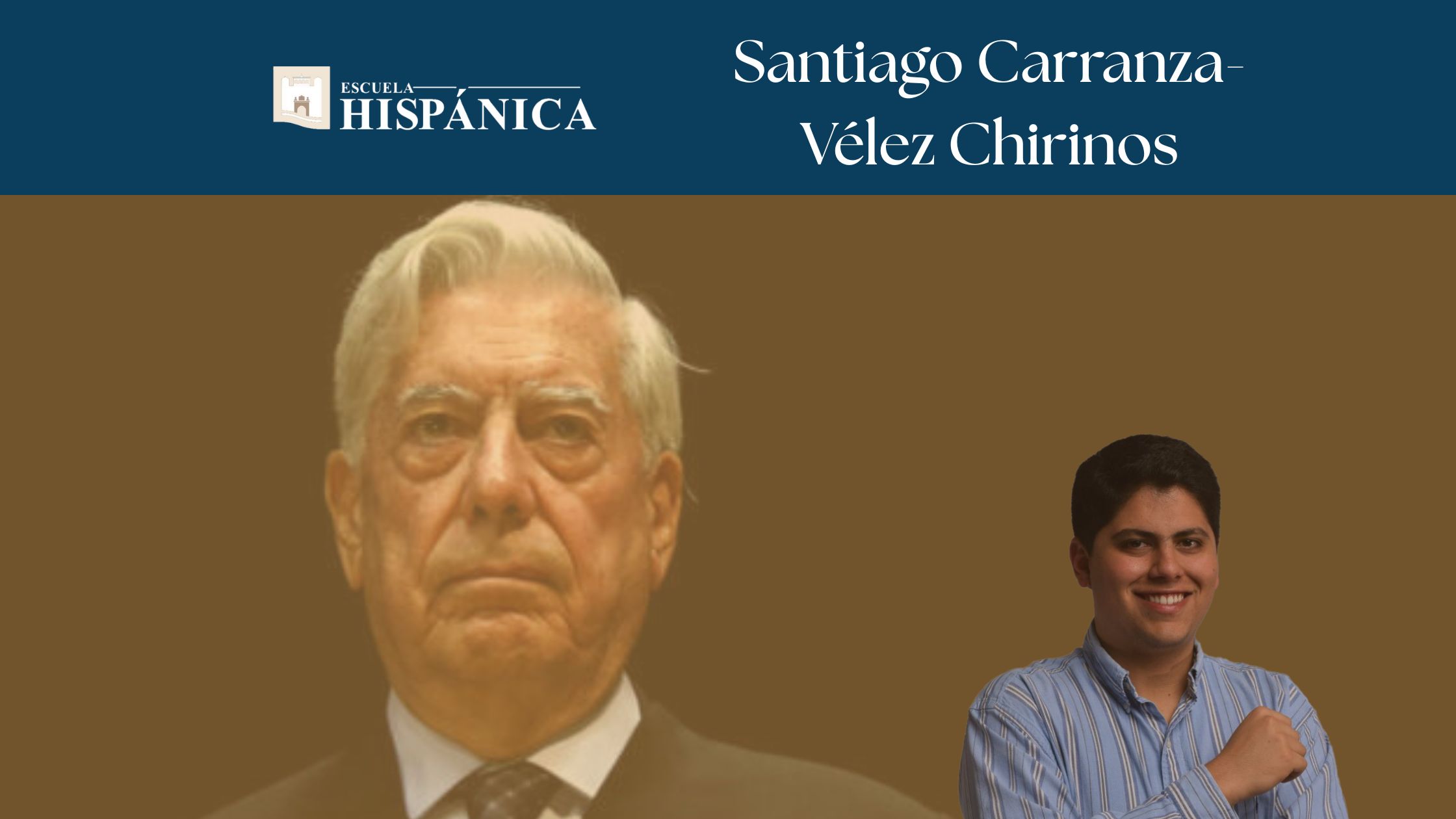
“At what precise moment had Peru fucked itself up?”
wondered Santiago Zavala on the first page of Conversation in the Cathedral. A haunting, melancholic question, born of Peruvian existential weariness — spleen, in Baudelaire’s words — that Vargas Llosa imprinted in that monumental novel and, above all, drove like a stake into the heart of every Peruvian concerned with the destiny of their country. A question without a definitive answer, one that lingers in the collective mind and resurfaces time and again in the press, in culture, and in conversation. A question destined to be as immortal as its author.
“If you keep behaving like that, I’ll send you to Leoncio Prado!”
This phrase — neutralising and immediate in its effect — could often be heard in my family and many others in Lima as a warning to restless children. Its true weight became clear when, already in secondary school and obliged by the reading syllabus, we came upon The Time of the Hero. A hard, passionate book for an adolescent, transforming that childhood threat into a narrative: dramas, violence, betrayal, authoritarianism, and emotional awakening within a military academy. Vargas Llosa achieved something extraordinary: he anticipated, through fiction, the real conflicts of our own adolescence in Lima.
As one grew older, the range of references expanded — many of them more mischievous or unsettling: Captain Pantoja and the Special Service, The Green House, Aunt Julia and the Scriptwriter. Vargas Llosa’s literature was, of course, inspired by Peru; yet what was most remarkable was that Peru — a country where half the population does not read even one book a year — had internalised his work. It was not uncommon to hear casual allusions to Lituma, Zambo Ambrosio, the Bad Girl, or Golden Foot in everyday conversation. Vargas Llosa had narrated our country with such precision that he had made it part of our speech.
As a child I lived in Miraflores, that coastal district of Lima, perpetually shrouded in mist, where many scenes of Vargas Llosa’s works unfold. I was surprised that such raw stories — and to me, so familiar — could arouse interest among international audiences. Why Vargas Llosa, and not other writers who also portrayed Lima, Piura, the jungle or the historic centre, had achieved such global resonance?
The reasons are many and certainly include his literary genius. But I have a hypothesis: Vargas Llosa dissected the Peruvian experience so deeply that he rendered it universal. He captured our contradictions and projected them onto the world with narrative rigour and critical lucidity. He saw more than ordinary Peruvians could see. And that, I think, was one of his first lessons: that from Peru one can also touch the universal.
Yet Vargas Llosa did not stop at literature. He sought to transform what he had understood. Hence he became not only a novelist, but also a public intellectual and, for a brief and turbulent period, a politician. His ideological evolution — from youthful social Christianity to committed socialism, and later to liberalism — has been the subject of both criticism and praise. He has been accused of vehemence, elitism, inconsistency. But if something can be said in his favour, it is his rare transparency: Vargas Llosa was one of the few Peruvian intellectuals who expressed his ideas with clarity — without half measures, without masks. And he did so, I believe, always from the conviction that Peru could be a freer and fairer country.
His foray into politics was brief, idealistic, and ended in defeat. Vargas Llosa proposed a liberal utopia in a political environment dominated by fear, corruption, and disinformation. He lost the election, and his defeat paved the way for an authoritarian regime. However, the ideas he defended during his campaign did not disappear: they helped to shape the country’s economic direction during the following decade. The economy was liberalised, and, later, politics was redemocratised. That was his project — a modern democracy grounded in economic freedom, in a country historically statist and authoritarian. Although he was not elected, his intellectual influence endured.
That is the second lesson he left us: the importance of ideas. Vargas Llosa understood that before public policies come convictions. And that a country which commits to liberal democracy has a better chance of prospering than one that falls into populist authoritarianism. His political legacy, beyond his mistakes, was having defended that principle consistently.
The third great lesson was that of national reconciliation. In a Peru torn by colonial, racial, and cultural wounds, Vargas Llosa defended a mestizo and inclusive identity. He rejected essentialist indigenism — not to deny the indigenous, but to refuse to freeze them in the past. And he defended Hispanism not as imposition but as a constitutive part of our history. It was a controversial stance, yes, but also a courageous one: he advocated for a country that need not choose between its roots — where Quechua and Cervantes, modernity and tradition, could coexist. That vision, unpopular in certain circles, was his wager for a more complete nation.
Vargas Llosa left us many lessons, but three stand out most powerfully in his legacy: the possibility of universality born from the Peruvian experience; the firm defence of liberal democracy as the foundation of development; and, perhaps the deepest, the pursuit of national reconciliation based on recognising our historical complexity. He transformed our tensions — between the indigenous and the Hispanic, the authoritarian and the democratic, the local and the universal — into literary and political reflection. He taught us that Peru could be thought of freely, without paralysing nostalgia or inherited resentment, and that we could aspire to a country where culture was stronger than exclusion. Growing up with Vargas Llosa was, ultimately, learning that criticism is a form of love — and that writing about Peru, with all its open wounds, can also be an act of hope.